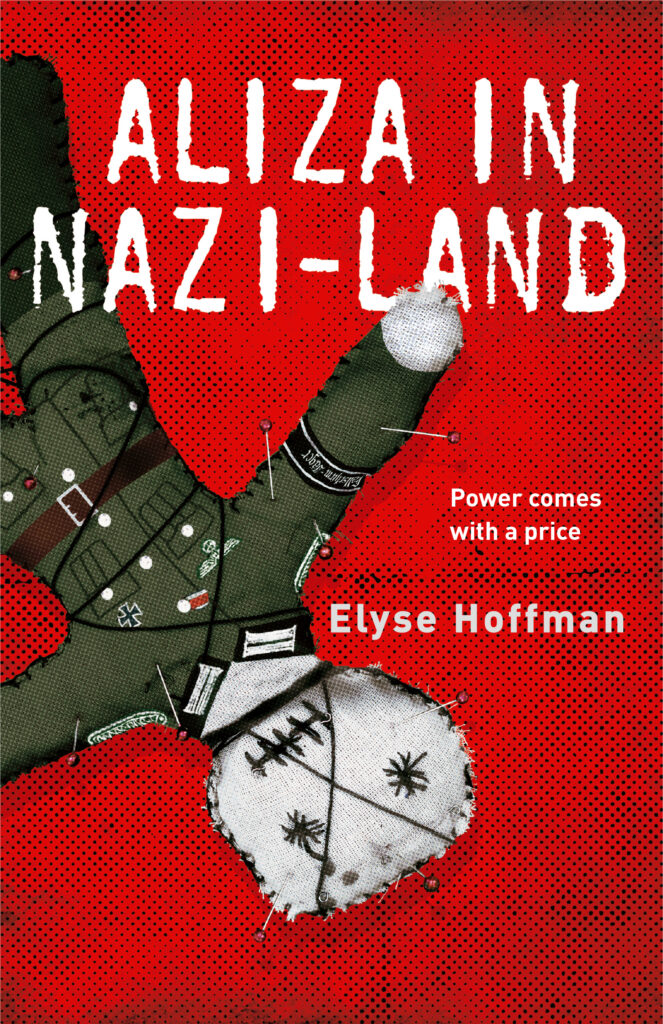
Earlier this year, in my The Hangman’s Master review, I pointed out how the “victim-turned-perpetrator” issue wasn’t present as I expected from such a book. Turns out it was only a matter of waiting just a few months, because Elyse Hoffman delivered a sequel to Stefan Harkel’s story that finally seems to go in that direction.
Aliza in Nazi-Land is set a few years after the end of World War II, and it follows a new master of the N1-zone, the one where the top level nazis are held captive and eternally captured. Aliza is a jew girl who survived the Holocaust and was rescued by the Black Foxes: she’s adopted by one of the Black Foxes and follows him to the United States together with her three foster sisters.
In a way that is only apparently a bit contrived (but it’s well explained later on in the book), she ends up with the most important contract in all Hell, and wastes no time in making the “best” out of it. She actually tries also to use it to gather information on a group of neo-nazi who is organising a march in the town she lives in, but torture is heavily involved in this investigation.
So yes, the book seems to be picking up exactly as The Hangman’s Master ends, but as the story unfolds you can see how different it is. For one, we actually see Aliza having a sort of crisis during one of her torture sessions. But also, as soon as we approach the end of the book and we find out who that contract belonged to and why they renounced it, the victim-perpetrators dynamic comes into play. In a sense you can see how someone that has suffered what Aliza and her peers have suffered wants a sort of retribution for that. But can such a thing ever be “even”? Doesn’t torturing your torturers make you exactly like them, or worse, because you’ve been on the other side and you know how humiliating it is?
And listen, I’m perfectly aware that this “dilemma” is in full display in real life, if we just bothered to look towards the Middle East. I won’t get deep into it because I don’t feel qualified to talk about this, I’m not an activist and I can’t say I’m really up to date with it, especially because there’s something about it that stings deep, but what I can say is that I thought about it a lot while reading this book. I’m not sure it was done on purpose, but it works.
In conclusion, I can’t finish this review without mentioning the final cliffhanger that will surely keep me on my toes waiting for the sequel to Aliza in Nazi-Land. It was quite a surprise, even though there was also a bit of foreshadowing in the earlier parts of the book, but it was very well played and I really really really can’t wait to see how it goes on.
Be First to Comment